
To remove stains from carpet, first blot the spill immediately with a clean, light-colored cloth or paper towel to absorb as much liquid as possible. Avoid rubbing or scrubbing, because this can spread the stain and push it deeper into the carpet fibers. After removing the excess liquid, apply a carpet-safe cleaning solution appropriate for the type of stain and carpet fiber. Work gently from the outside of the stain toward the center to prevent it from spreading. Blot the area repeatedly with a clean cloth until the stain lifts, then remove any remaining cleaning solution and allow the carpet to dry completely. For old, set-in, or stubborn stains, professional carpet cleaning may be more effective.
How Do Carpet Stains Form? (Before You Try Removing)
A carpet stain forms when a liquid or pigment moves past the surface of the carpet fiber and either bonds to it chemically or gets trapped mechanically inside the fiber and the backing beneath it. Understanding this is what separates a stain you can lift in five minutes from one that keeps coming back no matter how many times you clean it.
Carpet fiber is porous at a microscopic level. When a liquid lands on carpet, it doesn’t just sit on top — it’s pulled sideways and downward through tiny gaps between fibers by capillary action, the same physical force that draws water up a paper towel. The faster you blot up a spill, the less time capillary action has to pull it deeper into the pile and down into the carpet backing and pad underneath.
What happens next depends on what was spilled:
- Pigments and dyes (wine, juice, ink, mustard, curry) chemically bond to the fiber itself, especially on nylon and wool, which accept dye more readily than polypropylene.
- Proteins (blood, dairy, egg, vomit) coagulate and stick to fibers, and this bond gets stronger and harder to reverse when heat is involved.
- Tannins (coffee, tea, red wine) oxidize over time, which is why a coffee stain that looked pale brown on day one can look darker and more set a week later.
- Oils and fats (grease, butter, makeup) coat the fiber and resist plain water because oil and water don’t mix — you need a surfactant like dish soap to break the bond.
Why do some stains sink deeper?
Some stains sink deeper than others because of three factors working together: how much liquid was spilled, how long it sat before treatment, and how absorbent the carpet’s pile and pad are.
High-pile, plush carpets soak up more liquid before it reaches the backing simply because there’s more fiber for the spill to travel through, which sometimes buys you a little more time. Low-pile, looped carpets have less fiber to absorb the spill, so liquid reaches the backing and pad faster — meaning fresh spills need faster action on low-pile carpet, even though the visible stain often looks smaller.
Heat makes this worse. Walking a hot iron, hair dryer, or even direct sunlight over a fresh stain to “dry it faster” is one of the most common mistakes people make, because heat accelerates protein coagulation and dye bonding, effectively cooking the stain into the fiber. Cold or room-temperature treatment is safer for almost every stain type, and it’s required for protein-based stains like blood.
Once a spill reaches the pad underneath the carpet, it becomes significantly harder to fully remove with surface cleaning alone, because the pad is designed to absorb and hold moisture rather than release it. This is the point at which many stains that “come back” are actually never fully gone — they’re being pulled back up from the pad as the carpet dries.
Why do stains come back (wicking vs soiling)
A carpet stain that seems to disappear and then reappears hours or days later is almost always caused by one of two separate problems: wicking or resoiling. They look similar but have different causes and different fixes.
Wicking happens when part of a stain reaches the carpet pad or the base of the fiber and isn’t fully removed. As the carpet dries, moisture — carrying the leftover stain and any soil in the pad — travels back up through the fibers by the same capillary action that pulled the spill down in the first place. The result is a faint ring or blotch appearing where you thought the stain was gone, usually within 24 to 48 hours as the carpet finishes drying. Wicking is especially common with large spills, over-wetted cleaning attempts, and stains that sat for a long time before treatment.
Resoiling is a different mechanism: it happens when cleaning solution residue is left in the carpet after treatment. Many soaps, detergents, and some off-the-shelf carpet stain removers leave a slightly sticky residue if they aren’t fully rinsed out. That residue acts like a magnet for dirt and dust tracked across the carpet afterward, so the treated spot gets dirty again faster than the carpet around it — which can look exactly like a stain “coming back,” even though it’s actually new dirt.
To prevent both:
- Rinse every treated area with a small amount of clean, cool water after applying any cleaning solution, and blot until the area is only lightly damp — never leave cleaning solution to dry in the carpet.
- Avoid over-wetting. Use only as much liquid as needed to work the stain, and always blot up excess rather than letting it soak further in.
- Weigh down a stack of white paper towels or a clean cloth over a treated spot and leave it for a few hours or overnight to draw out remaining moisture from deeper in the pile and pad — this single step prevents more “stains that come back” than any product.
If a stain keeps returning after you’ve rinsed thoroughly, dried it properly, and it still reappears darker or with an odor, that’s usually a sign the spill reached the pad and needs professional hot water extraction rather than another round of surface cleaning — covered in more detail later in this guide.
How to Remove Tough or Old Carpet Stains
Why do old stains behave differently?
Old and dried carpet stains behave differently from fresh spills because time changes the chemistry, not just the appearance, of the stain. Three things happen the longer a stain sits:
- Dye and tannin stains oxidize. Coffee, tea, and wine stains react with air over time and darken, becoming more color-fast and harder to lift with the same method that would have worked on day one.
- Protein stains cross-link. Blood, vomit, and dairy proteins form stronger molecular bonds with carpet fiber as they dry and age, which is why a week-old blood stain resists the same hydrogen peroxide treatment that removes a fresh one almost instantly.
- The stain penetrates deeper. Given more time, a spill continues migrating downward into the pile and pad even without visible liquid on the surface, so what looks like a surface stain may have already reached the backing.
This means old stains typically need rehydration before they can be treated at all, more dwell time for the cleaning solution to work, and — honestly — sometimes only partial improvement rather than complete removal, especially if the dye has fully bonded to a light-colored, absorbent fiber like wool or nylon.
How to loosen dried stains
- Rehydrate the stain first. Dampen the area with cool water and let it sit for 5–10 minutes. This softens dried residue and reopens the fiber slightly so cleaning solution can actually reach the stain instead of sitting on top of a hardened crust.
- Loosen dried residue mechanically. Use the dull edge of a spoon or a soft-bristle brush to gently break up any crusted material, working from the outside of the stain toward the center to avoid spreading it further.
- Vacuum loose debris before applying any liquid cleaner, so you’re not working wet debris deeper into the pile.
- Apply your chosen cleaning solution (matched to the stain type — see the stain-by-stain sections below) and give it longer dwell time than you would for a fresh stain, typically 10–15 minutes instead of 1–2.
Best method for removing old stains
For most old, dried stains, a vinegar and dish soap solution followed by hydrogen peroxide (on light or white carpet only, after a patch test) gives the best balance of effectiveness and safety:
- Mix 1 tablespoon of white vinegar, 1 teaspoon of clear dish soap, and 2 cups of cool water in a spray bottle.
- Saturate the stain lightly and let it sit for 10 minutes.
- Blot thoroughly with a clean white cloth.
- If color remains and the carpet is light-colored, apply a small amount of 3% hydrogen peroxide directly to the spot, wait 5 minutes, then blot again.
- Rinse with clean water and dry thoroughly, weighing down white paper towels overnight if needed.
Set realistic expectations: an old stain may fade significantly without disappearing completely, particularly on carpet that’s been exposed to sunlight (which can already have lightened the surrounding fibers, making the treated spot look different rather than clean) or where the dye has permanently bonded to the fiber. If a stain doesn’t respond after two full treatment attempts, further scrubbing is more likely to damage the pile than remove more color — that’s the point to consider professional spot treatment.
Quick fixes when nothing else works
- Steam. A garment steamer or the steam setting on an iron (held several inches away, never touching the carpet directly) can help loosen very old, waxy, or oily residue that liquid alone won’t budge — follow immediately with blotting.
- Repeat, don’t escalate. Multiple gentle applications of a mild solution consistently outperform one aggressive application of a harsh one, and are far less likely to damage the carpet.
- Camouflage as a last resort. For a stain that’s genuinely permanent (common with old dye stains on light carpet), furniture placement or a small area rug is a legitimate, low-risk option while you plan for professional cleaning or eventual carpet replacement of that section.
- Call a professional if the stain is large, has clearly reached the pad, or is on a wool or specialty rug — see the dedicated section on when to call a professional later in this guide.
Stain Cleaning Basics
Every stain-removal method in this guide relies on three fundamental techniques. Getting these right matters more than which specific solution you use.
Blot
Blotting means pressing a clean, absorbent cloth or paper towel straight down onto the stain and lifting it away, repeating with a clean section of cloth each time, rather than dragging or rubbing the cloth across the carpet.
Why blotting works and scrubbing doesn’t: Carpet fibers have a natural direction and structure. Rubbing or scrubbing distorts and frays that structure, which does two things badly: it pushes stain particles further down into the pile and pad (working against everything you’re trying to do), and it spreads the stain outward, turning a small, defined spot into a larger, fuzzy-edged one that’s harder to treat. Blotting, by contrast, physically lifts liquid and loosened stain material up and out of the fiber.
How to blot correctly: work from the outer edge of the stain inward, not the center outward — this prevents the stain from spreading into clean carpet as you work. Use white cloths or plain white paper towels whenever possible; colored or patterned towels can transfer their own dye onto damp carpet, adding a new stain on top of the one you’re removing. Press firmly and hold for a few seconds rather than dabbing quickly, and switch to a clean, dry section of cloth as soon as the one you’re using picks up color or moisture.
Apply
Applying means putting a cleaning solution onto the stain — never pouring it directly onto the carpet.
The correct method is to dampen a clean white cloth with your chosen solution and dab or gently press it onto the stain, letting the solution transfer from cloth to carpet in a controlled way. Pouring liquid directly onto carpet almost always leads to over-wetting, which increases the risk of wicking (covered above) and can push the stain into the pad before you’ve even started cleaning it.
Always apply a small amount first and test it on an inconspicuous area — inside a closet, under a piece of furniture, or a remnant if you have one — and wait a few minutes to check for any color change before treating the visible stain. This single step prevents the majority of “the cleaner made it worse” situations.
Scrape
Scraping is for solid or semi-solid material — gum, dried food, wax, or thick spills — that needs to be physically lifted off the carpet before any liquid treatment begins.
Use the dull edge of a spoon, a plastic scraper, or a dull butter knife, and always scrape from the outer edge of the material toward the center. Scraping outward from the center pushes material into clean fibers around the stain; scraping inward contains it. Never use a sharp knife or the scraping edge of a tool that could cut carpet fibers — a dull edge lifts solid material without damaging the pile underneath.
Cleaning Solutions to Have on Hand
Keeping a small carpet-stain kit ready means you can act in the first few minutes after a spill, which matters more than which specific product you eventually use. This is a genuinely useful “always stocked” list — not just for wine and coffee, but for the full range of household stains covered later in this guide.
| Item | What it’s for | Safety note |
| White cloths or plain paper towels | Blotting every stain type | Colored towels can transfer dye onto wet carpet |
| Spray bottle | Applying diluted solutions evenly | Label it — never reuse a spray bottle that held bleach for anything else |
| Clear, uncolored dish soap | Grease, oil, and general spot cleaning | Colored/scented dish soap can leave its own residue or tint |
| White vinegar | Tannin stains (coffee, tea, wine), odor neutralizing, general all-purpose spotting | Avoid on natural stone-adjacent trim or true silk rugs; safe for most synthetic and wool carpet when diluted |
| Baking soda | Absorbing fresh spills, deodorizing, paste for stubborn stains | Vacuum up fully after use — leftover powder can dull carpet appearance |
| 3% hydrogen peroxide | Blood, protein stains, brightening light carpet | Can lighten color; always patch-test, avoid on dark or dyed carpet |
| Enzymatic cleaner | Pet urine and other protein/organic stains and odors | The only product type that fully breaks down uric acid crystals rather than just masking odor — essential for pet households |
| Soft-bristle brush | Working solution into pile gently, loosening dried debris | Never use a stiff wire brush — it will damage fiber |
| Plastic scraper or dull spoon | Removing solid material before liquid treatment | Avoid sharp-edged tools |
| Clean, dry white towels or paper towel stack | Final drying and weighting down treated spots | Replace regularly during the drying process |
A critical safety note that belongs here, not buried later in this guide: never mix bleach with ammonia or with vinegar-based cleaners. Combining bleach with ammonia produces toxic chloramine gas, and combining bleach with acidic cleaners like vinegar releases chlorine gas — both are dangerous in an enclosed room. If a stain has already been treated with one type of cleaner and hasn’t worked, rinse the area thoroughly with plain water and let it dry before trying a different product category.
Removing specific stains from carpet
How to get burn marks out of carpet
Burn marks aren’t a stain in the chemical sense — no cleaning solution will reverse melted or charred carpet fiber, because the fiber itself has been physically damaged, not just discolored. What you can do depends on the severity:
- Very light scorching: gently trim the singed fiber tips with small, sharp scissors, working carefully to blend with surrounding pile height.
- Small, localized burns: a professional carpet repair technician can often cut out the damaged tuft and patch in matching fiber from a hidden area (like a closet) — this is a repair service, not a cleaning one.
- Larger burns: these typically require a patch of replacement carpet or, in severe cases, professional replacement of that carpet section.
Never try to “clean” a burn mark with stain removers or vinegar solutions — they won’t do anything to melted or charred fiber and may spread ash or residue into surrounding clean carpet.
How to get paint out of carpet
The right method depends entirely on whether the paint is water-based (latex, most craft and wall paint) or oil-based (some trim paints, enamels, certain craft paints) — using the wrong approach on the wrong paint type either does nothing or makes the spill larger.
Water-based (latex) paint, while still wet:
- Scrape up excess paint with a dull spoon, working from the outside in.
- Blot with a cloth dampened in warm water and a few drops of dish soap.
- Rinse by blotting with plain water, then dry.
Water-based paint, already dried:
- Soften the paint with a cloth soaked in warm water and dish soap, pressed onto the spot for several minutes.
- Gently scrape away softened paint, then repeat blotting and rinsing.
- Stubborn dried residue may need several rounds — resist the urge to scrub, which can drive paint deeper.
Oil-based paint: dish soap and water won’t dissolve it. Blot up excess, then apply a small amount of rubbing alcohol or a dry-cleaning solvent on a cloth (always patch-test first, since solvents can affect synthetic fibers), dab gently, and blot with a clean cloth until the paint lifts. Rinse with water afterward to remove solvent residue.
How to get blood out of carpet
Blood is a protein-based stain, and the single most important rule is cold water only — never warm or hot. Heat causes blood proteins to coagulate and bond permanently to carpet fiber, which is exactly the opposite of what you want.
For fresh blood stains:
- Blot up as much as possible with a clean cloth and cold water — don’t rub.
- Mix 1 teaspoon of clear dish soap with 2 cups of cold water and blot the solution onto the stain.
- Rinse by blotting with more cold water, then dry.
For dried or set blood stains:
- Apply 3% hydrogen peroxide directly to the stain (patch-test on colored carpet first — it can lighten dye).
- Let it bubble and sit for 3–5 minutes; the bubbling is the peroxide breaking down the protein.
- Blot away with a clean cloth, repeating as needed.
- Rinse with cold water and dry thoroughly.
An alternative for wool or delicate carpet where hydrogen peroxide feels too aggressive: make a paste of cold water and salt, work it gently into the stain, let it dry, then vacuum and repeat as needed — a gentler, slower method that avoids any bleaching risk.
how to remove coffee stain from carpet
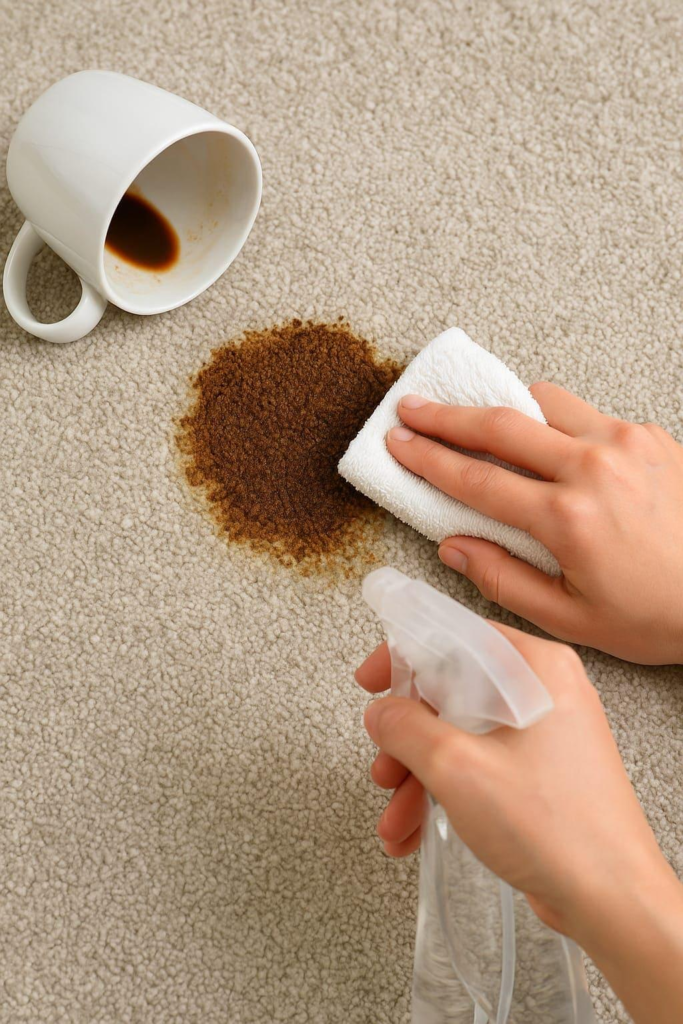
To remove a coffee stain from carpet, immediately blot the area with a clean, dry towel or paper towel to absorb as much coffee as possible. Avoid scrubbing, as rubbing can spread the stain and push the coffee deeper into the carpet fibers and padding. Once the excess liquid is absorbed, treat the remaining stain with an appropriate carpet-safe cleaning solution and blot gently until the stain lifts.
How to get red wine out of the carpet
Red wine combines two stain types at once — tannins (which oxidize and darken over time) and dye (which bonds to fiber, especially nylon and wool) — which is why it has a reputation as one of the hardest household stains.
Immediate steps (the first two minutes matter most):
- Blot — don’t rub — with a clean white cloth to absorb as much wine as possible before it spreads or soaks in.
- Cover the stain generously with table salt or baking soda while it’s still wet; both are absorbent and will pull a surprising amount of wine out of the fiber as they sit. Leave for 10–15 minutes, then vacuum thoroughly.
- Apply a solution of 1 tablespoon dish soap, 1 tablespoon white vinegar, and 2 cups warm water, blotting it onto the remaining stain.
- Blot with plain water to rinse, then dry.
A note on the “pour white wine on red wine” and club soda tricks: these are widely repeated online, but the evidence for either is mostly anecdotal rather than tested. Club soda’s mild carbonation and salt content can help lift a very fresh stain slightly, similar to plain water, but it isn’t meaningfully better than the salt-and-dish-soap method above. Pouring more wine onto a stain to “dilute” it isn’t a reliable mechanism and risks adding more liquid than it removes — salt or baking soda is the more dependable first move.
For dried red wine stains, rehydrate first (see the old-stains section above), then use the same dish soap and vinegar solution with a longer dwell time, followed by hydrogen peroxide on light-colored carpet if color remains. Bleach can remove stubborn dried red wine from white or very light carpet, but only when heavily diluted and only after testing — see the bleach method in the numbered list below for exact ratios and important cautions.
How to get stains out of carpet caused by sick
Vomit is a combination of stomach acid and partially digested protein, which means it needs two things regular detergent alone doesn’t fully address: acid neutralization and enzymatic breakdown.
- Put on gloves. Scrape up solid material with a plastic bag over your hand or a dull scraper, working from the outside in, and dispose of it in a sealed bag.
- Blot up remaining liquid with paper towels.
- Sprinkle baking soda generously over the area — this neutralizes stomach acid and begins absorbing odor, not just moisture. Let it sit for 15–20 minutes, then vacuum.
- Apply an enzymatic cleaner (the same type used for pet stains) to break down remaining protein and bile residue, following the product’s dwell time.
- Rinse by blotting with cool water, then dry thoroughly, ideally with a fan or open window for ventilation.
If odor persists after the carpet is fully dry, that’s a sign some residue reached the pad — repeat the enzymatic treatment rather than switching to a stronger detergent, which won’t address the organic material the way an enzyme cleaner does.
How to get a tea stain out of carpet
Tea is a tannin-based stain, chemically similar to coffee and red wine, and it responds to the same core method — though tea can leave a slightly more yellow-toned residue on light carpet that’s worth watching for.
- Blot up excess liquid immediately.
- Apply a solution of 1 tablespoon white vinegar, 1 teaspoon dish soap, and 2 cups cool water.
- Blot gently, working from the outside in, and repeat until no more color transfers to the cloth.
- Rinse with plain water and dry.
For a stain that’s already dried, treat it the same as an old stain (rehydrate, then apply solution with longer dwell time). On very light or white carpet, a small amount of hydrogen peroxide after the vinegar step, patch-tested first, will address any lingering yellow tint.
Cleaning Vomit from Carpet
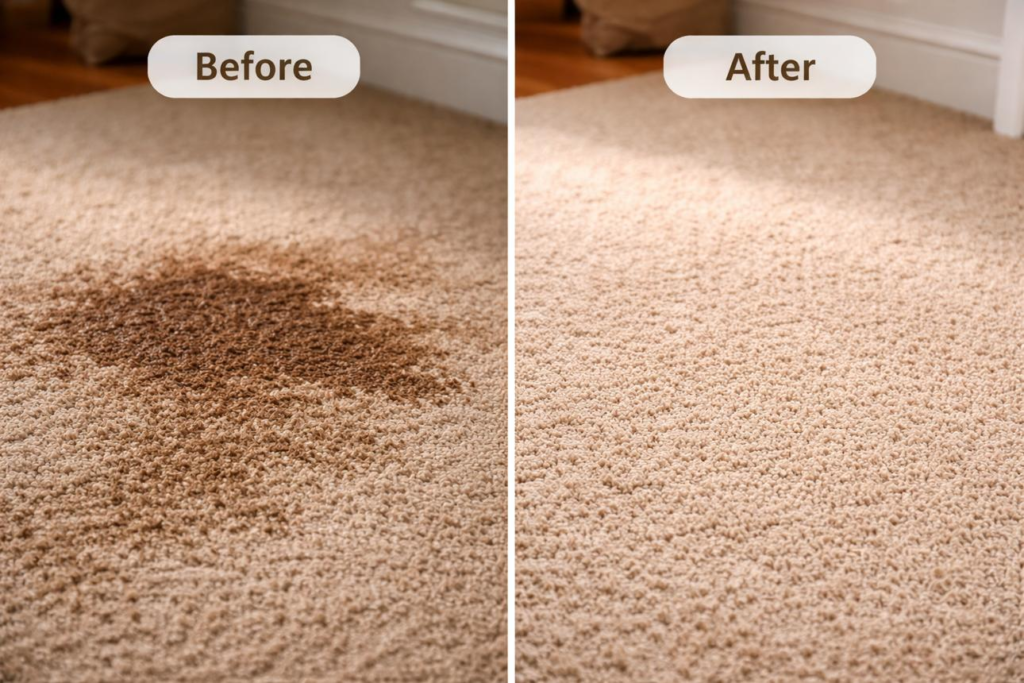
This follows the same protocol as “sick” above, since vomit and sick describe the same substance — see that section for the full step-by-step method, including the baking soda acid-neutralizing step and the enzymatic cleaner treatment that’s essential for fully removing both the stain and the odor rather than just the visible mess.
How to Remove Chewing Gum from Carpet
Gum needs to be hardened before it can be removed cleanly — trying to pull soft gum out of carpet fiber almost always leaves residue behind and can pull out fibers with it.
Freeze method (best for most cases):
- Fill a plastic bag with ice cubes and hold it directly against the gum for 10–15 minutes, until it’s completely hard and brittle.
- Once frozen solid, gently crack the gum apart with the dull edge of a spoon or butter knife.
- Pick out the pieces by hand, working from the edges toward the center.
- Vacuum up any remaining crumbs before they have a chance to soften again.
Softening alternative (for gum ground deep into the pile): if gum has been worked into the base of the fibers rather than sitting on top, warm white vinegar applied on a cloth and pressed against the gum for a few minutes can soften the adhesive enough to work it loose with a soft brush, taken slowly to avoid pulling fibers.
Whichever method you use, pull gently and stop if you feel resistance — forcing gum out that’s still partially attached is the most common way this job ends up damaging the carpet pile.
How to Remove Soft Drink Spills from Carpet
Soft drink spills fall into two categories that need slightly different attention: clear, sugary sodas and brightly dyed drinks like fruit punch, sports drinks, or red soda.
Clear or lightly colored soda:
- Blot up excess liquid.
- Apply dry baking soda over the damp area and let it absorb for a few minutes, then vacuum.
- Treat with a dish soap and warm water solution, blot, then rinse thoroughly — soda’s sugar content leaves a sticky residue that attracts new dirt if it isn’t fully rinsed out, so give this step extra attention compared to a plain water spill.
- Dry completely.
Dye-heavy drinks (fruit punch, sports drinks, red soda, Kool-Aid): these carry an artificial dye that behaves more like the dye in red wine or juice than like plain sugar water, so treat the color component separately. After the baking soda and dish soap steps above, if color remains, apply a small amount of 3% hydrogen peroxide (light carpet only, patch-tested) or an oxygen-based stain remover formulated for dye stains, following the product’s directions and rinsing thoroughly afterward.
How to Remove Ink Stains from Carpet
Ink type determines the method — using the wrong one either does nothing or spreads the stain.
Water-based ink (most washable markers):
- Blot, don’t rub.
- Apply a solution of dish soap and cool water, blotting gently.
- Rinse and dry.
Ballpoint pen and permanent/oil-based ink (including permanent marker):
- Blot excess ink immediately with a dry cloth — do not use water first, which can spread oil-based ink further.
- Dampen a clean cloth with rubbing (isopropyl) alcohol and dab, not rub, working from the outer edge inward. Always patch-test first, since alcohol can affect dye in some synthetic carpets.
- Blot with a clean section of cloth as ink transfers, switching often.
- Once the ink has lifted as much as it will, rinse the area with a damp cloth and dry.
For India ink or heavily set permanent marker, professional treatment is usually the more reliable option — these are genuinely among the hardest household stains to fully remove with DIY methods, and aggressive at-home attempts risk spreading the stain or damaging fiber before you get meaningful results.
How to Remove Nail Polish from Carpet
The biggest risk with nail polish isn’t the stain itself — it’s using the wrong remover on the wrong carpet fiber. Acetone-based nail polish remover can actually melt or dissolve polypropylene (olefin) carpet fiber, since polypropylene has a relatively low melting point and reacts to solvents the way it would to direct heat. This is a real risk, not a minor caution, and it’s the reason “just use nail polish remover” advice found elsewhere can genuinely damage synthetic carpet.
- Scrape up any excess wet polish carefully with a dull tool before it spreads.
- Identify your carpet fiber if possible (see the carpet material section below) — for wool and nylon, a small amount of non-acetone nail polish remover is generally safer; for polypropylene/olefin carpet, avoid acetone-based products entirely.
- Always patch-test in a hidden area first.
- Apply remover to a cotton swab, not directly to the carpet, and dab gently at the edge of the stain, working inward.
- Blot with a clean white cloth as polish lifts, switching to a clean section frequently.
- Rinse the area with water once the polish is gone and dry thoroughly.
If you’re unsure what your carpet is made of, treat it as polypropylene and avoid acetone — the downside of using a gentler product is a little more effort, while the downside of guessing wrong with acetone can be visible fiber damage that isn’t repairable with cleaning.
How to Remove Food Messes from Carpet
Food stains respond best when you treat them by category rather than trying one method for everything — an oily mess, a dye-heavy sauce, and a sugary sweet all need different approaches.
Oily and fatty messes (butter, greasy sauces, peanut butter, oily salad dressing):
- Scrape off excess.
- Apply dry baking soda or cornstarch to absorb surface oil for a few minutes, then vacuum.
- Treat with a dish soap solution — dish soap is specifically formulated to break down grease, which is why it outperforms plain detergent here — blot, rinse, and dry.
Dye-heavy sauces and spices (tomato sauce, mustard, curry): these are dye-based stains, and curry in particular is notoriously stubborn because turmeric (curcumin) is a very strong, fast-bonding natural dye that stains almost as aggressively as ink.
- Scrape up solids immediately.
- Apply baking soda to absorb and lift moisture, then vacuum.
- Use an enzyme pre-soak or oxygen-based stain remover rather than plain detergent — dye stains like curry typically need an oxidizing or enzymatic product to fully break the pigment bond, not just soap.
- Rinse and dry, and expect to repeat the treatment for curry specifically, since it rarely lifts completely in one pass.
Sugary and sticky messes (chocolate, ice cream, syrup):
- Scrape off solid or semi-solid material.
- Blot with a warm (not hot) dish soap solution to dissolve sugar and fat content together.
- Rinse thoroughly — sticky residue left behind will attract dirt and make the spot look dingy again within days if it isn’t fully rinsed out.
How to Remove Stains From Every Type of Carpet Material
Carpet fiber type changes both how easily a stain sets and which cleaning products are safe to use. Using a method that’s fine for one fiber can damage another, so identifying your carpet material before treating a stain is worth the extra minute.
| Fiber | Stain resistance | Sensitive to | Safest cleaners |
| Wool | Moderate — natural fiber accepts some dye readily | High pH (alkaline) cleaners, bleach, high heat | Mild, pH-neutral or slightly acidic solutions (diluted vinegar) |
| Nylon | Moderate to low without a factory stain-resist treatment | Strong bleach and alkaline products | Mild detergent solutions, tested first |
| Polypropylene (olefin) | High — resists water-based stains well | Heat and solvents (including acetone) | Water-based detergent solutions; avoid heat and solvent-based removers |
| Polyester | High — similar water resistance to polypropylene | Oil-based stains penetrate more easily than water-based ones | Dish soap solutions for oily stains; standard methods otherwise |
How to remove stains from wool carpets
Wool is a protein fiber, chemically similar to hair, which is why it needs gentler handling than synthetic carpet. High-pH (alkaline) cleaners and bleach can yellow wool or break down the fiber structure over time, and high heat can cause the fiber to felt or shrink slightly. Because wool is naturally somewhat acid-tolerant, mildly acidic solutions — diluted white vinegar being the most accessible — are actually safer for wool than many “gentle” alkaline cleaning products marketed for general use. Always patch-test, use cool water only, and for valuable or antique wool rugs, professional cleaning is worth the cost rather than risking a DIY method on a fiber that’s expensive to replace.
How to remove stains from nylon carpets
Nylon is a resilient, dyeable synthetic fiber, which is exactly why it can be trickier with stains than people expect — its ability to take dye well as a manufacturing feature also means it absorbs stain dye readily, especially on carpet without a factory-applied stain-resist coating. Most nylon carpet responds well to the standard dish soap and vinegar methods throughout this guide, but strong bleach and highly alkaline products should still be patch-tested, since they can affect nylon’s color over repeated use even though the fiber itself is fairly durable.
How to remove stains from polypropylene carpets
Polypropylene, also called olefin, is one of the most stain-resistant common carpet fibers because it’s non-porous — most water-based stains sit on the surface rather than soaking into the fiber itself, which is why they’re often easier to blot away completely. The tradeoff is polypropylene’s low melting point: avoid hot water, steam, and high-heat cleaning equipment, and avoid solvent-based products like acetone nail polish remover (see the nail polish section above), all of which can physically melt or distort the fiber rather than just failing to clean it.
How to clean light coloured carpets safely
Light and white carpet needs two extra precautions that darker carpet doesn’t: dye transfer risk and visibility of any residue or discoloration. Use only white cloths and paper towels — colored ones can transfer their own dye onto damp light carpet. Favor color-safe, oxygen-based cleaning products over anything containing dyes or strong bleach unless you’ve specifically tested the bleach method described later in this guide. Always patch-test any new product in a hidden area, since light carpet shows both under-treatment (leftover stain) and over-treatment (bleaching or dulling) far more visibly than dark carpet does.
15 Ways to Remove Difficult Stains from Your Carpet
Each method below includes what it’s best suited for, the ratio to use, how long to let it sit, and any important caution — treat this as a reference to match to your specific stain rather than a list to try in order.
1. Gently Rinse the Accident Spot
Best for: any fresh spill, as a first response before applying anything else. Blot up as much liquid as possible, then dampen a clean white cloth with cool water and blot the area to dilute what remains. This alone removes a meaningful amount of most fresh stains and should always be your first move regardless of what caused the spill.
2. Use a Carpet Shampoo (if needed)
Best for: general spot cleaning when a stain doesn’t respond to plain water. Follow the product’s dilution instructions exactly — using carpet shampoo stronger than directed doesn’t clean better, it just leaves more residue behind, which increases the risk of resoiling described earlier in this guide. Always rinse and blot dry afterward.
3. All-Purpose DIY Stain Spray
Best for: general, unidentified stains and everyday spot cleaning. Ratio: 1 tablespoon dish soap, 1 tablespoon white vinegar, 2 cups warm water in a spray bottle. Time: apply, let sit 5 minutes, blot. Caution: patch-test on wool and colored carpet.
4. Vinegar-Based Stain Removal
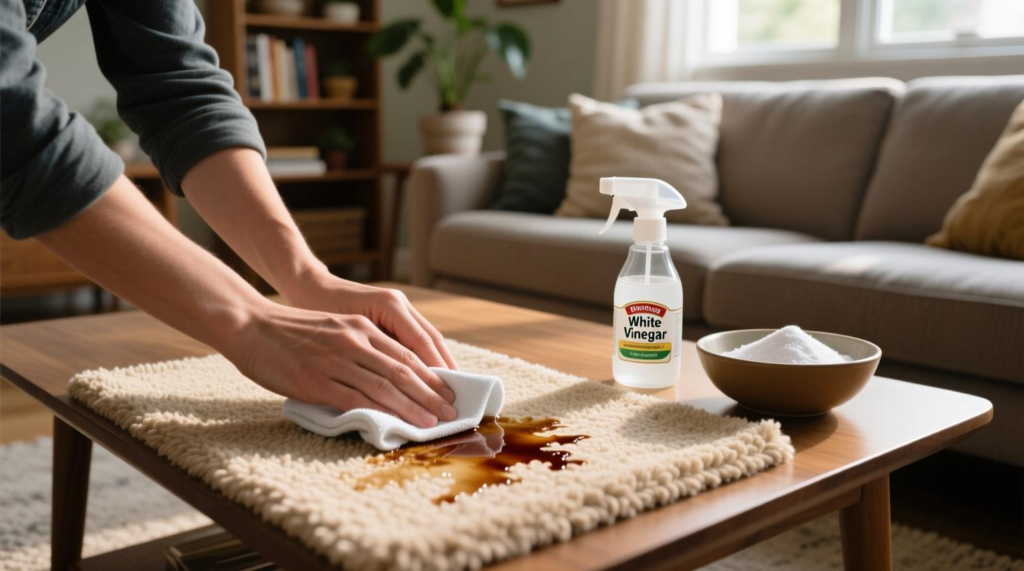
Best for: tannin stains (coffee, tea, wine) and general odor neutralizing.
Vinegar + Baking Soda
Ratio: sprinkle baking soda over the stain, then spray with a 1:1 white vinegar and water solution. Time: let it fizz and sit until dry (usually 15–20 minutes), then vacuum. Caution: the fizzing reaction is baking soda (a base) reacting with vinegar (an acid), which helps physically lift residue — it isn’t a stronger cleaner chemically, just a mechanical loosening action.
Vinegar + Liquid Detergent
Ratio: 1 tablespoon vinegar, 1 teaspoon liquid dish detergent, 2 cups warm water. Time: apply, sit 5 minutes, blot, rinse. Caution: don’t substitute colored or scented detergent, which can leave its own residue.
Other Vinegar Solutions
Undiluted white vinegar applied directly on a cloth (not poured on carpet) works well for tough red wine or blood residue after the initial dish soap step, with a 10-minute dwell time before blotting and rinsing.
5. Baking Soda Stain Removal
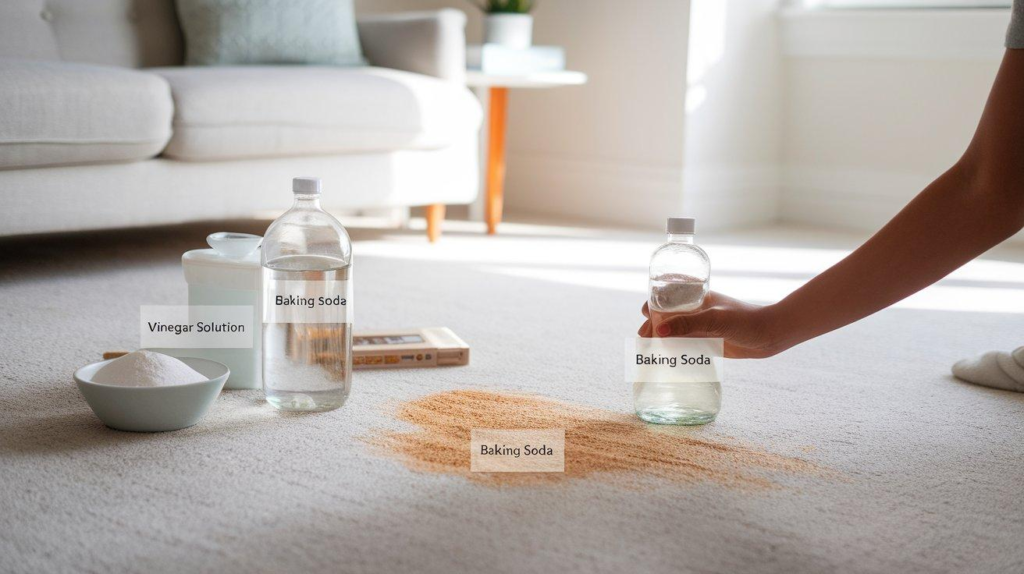
Best for: absorbing fresh spills, deodorizing, and lifting fresh wine or juice before it sets.
Baking Soda Alone
Method: sprinkle generously over a fresh, still-damp stain; let sit 15–20 minutes; vacuum. Caution: vacuum thoroughly — leftover powder in the pile can look dull or grayish over time.
Hydrogen Peroxide + Baking Soda
Ratio: make a thick paste with 2 tablespoons baking soda and 1 tablespoon 3% hydrogen peroxide. Time: apply, let sit 10 minutes, then blot and rinse. Caution: peroxide can lighten dark or dyed carpet — patch-test first; best reserved for light-colored carpet.
6. Detergent & Soap-Based Stain Removal
Best for: oily and fatty stains, general spot cleaning.
Mild Detergent
Ratio: a few drops of clear, uncolored detergent in 2 cups lukewarm water. Time: dab, repeat until stain lifts, then rinse.
Liquid Detergent Solution
Similar to above but slightly stronger — 1 teaspoon detergent per cup of water — for tougher grease or food stains. Rinse thoroughly to avoid resoiling.
Hydrogen Peroxide + Soap
Ratio: 1 part 3% hydrogen peroxide to 1 part clear liquid soap. Time: apply, wait 1–2 minutes, blot with a clean, dry cloth. Caution: effective on protein and tannin stains on light carpet; patch-test on any colored carpet first.
7. Salt Method
Best for: fresh red wine and other fresh liquid spills, as an absorbent first response. Cover the still-wet stain completely with table salt. Leave until the salt has absorbed the liquid and dried (usually 15–30 minutes), then vacuum thoroughly. The salt pulls a significant portion of the stain out mechanically before it has a chance to set.
8. Soda Water Method
Best for: fresh coffee, tea, and wine stains. Method: pour a small amount of plain soda water (club soda) onto the stain, let sit 15–30 minutes, and blot with a cloth or sponge. Effectiveness is comparable to plain cool water for most stains — the mild carbonation offers a slight lifting benefit but isn’t dramatically stronger than the salt or vinegar methods above.
9. Bleach Method (For Suitable Carpets Only)
Best for: stubborn, set-in stains on white or very light, bleach-safe carpet only — never on colored, wool, or nylon carpet without extensive testing, since bleach can strip dye and damage protein-based fibers. Ratio: 1 part bleach to 6 parts water in a spray bottle. Time: lightly mist the stain, let sit 10–15 minutes, then blot with a damp white cloth. Critical cautions: always wear gloves and ensure the room is ventilated. Never combine with ammonia or vinegar-based products — this produces toxic gas. Always patch-test in a hidden area first, since even diluted bleach can yellow or weaken some carpet fibers. This method is best suited to genuinely white, all-synthetic carpet; if you’re unsure of your carpet type, skip this method in favor of hydrogen peroxide, which is milder.
10. Beer for Coffee Stains
Best for: fresh coffee stains, as an old home remedy. Method: dab a small amount of flat beer onto the stain and blot. Caution: the evidence for this working better than plain water or a dish soap solution is largely anecdotal rather than tested — it’s a low-risk option to try on a fresh stain if you have it on hand, but it shouldn’t replace the dish soap and vinegar method above as your primary approach, and beer can add its own sugar residue that needs rinsing out.
11. Ammonia Solution
Best for: some grease and protein-based stains. Ratio: 1 tablespoon clear ammonia to 1 cup water. Time: apply, let sit 3–5 minutes, blot, rinse thoroughly. Critical caution: never combine ammonia with bleach or bleach-containing products — this produces toxic chloramine gas. Use in a well-ventilated room only, and never use this method in the same cleaning session as the bleach method above, even on different stains in the same room.
12. White Wine for Red Wine Stains
Best for: an emergency option for fresh red wine spills when nothing else is available. Method: dab white wine onto a fresh red wine stain and blot immediately. Caution: like the beer method above, this is a widely repeated folk remedy with limited actual evidence behind it. Salt or baking soda (methods 7 and 5) are more reliably effective and don’t add extra liquid to a stain that’s already wet — treat this as a last resort, not a first choice.
13. Natural Stain Remover for Wool Carpets
Best for: wool carpets and rugs, where harsher chemical products carry more risk. Ratio: 1 tablespoon white vinegar, 1 teaspoon mild, clear dish soap, 2 cups cool water. Time: apply gently, let sit 5 minutes, blot, rinse with plain cool water. Why this combination works for wool specifically: wool is naturally more tolerant of mild acids (like diluted vinegar) than of alkaline products, which can damage the protein structure of the fiber — this is the gentlest effective option covered in this guide for wool.
14. When DIY Methods Don’t Work
If you’ve tried an appropriate method for your stain type twice with proper technique — correct dilution, adequate dwell time, and thorough rinsing — and the stain hasn’t meaningfully improved, further attempts with the same or a stronger product are more likely to damage the carpet than remove more of the stain. This is the point to stop rather than escalate to a harsher chemical or more aggressive scrubbing.
Signs that DIY has reached its limit:
- The stain has clearly reached the carpet pad (it feels damp well below the surface, or an odor persists after full drying).
- Color remains after two full treatment cycles with an appropriate, correctly matched method.
- The carpet is wool, an antique rug, or otherwise high-value, where an over-aggressive DIY attempt risks fiber damage that’s expensive or impossible to reverse.
- You’re tempted to try combining chemical products to “boost” the effect — this is a safety risk, not a solution (see the ammonia/bleach warning above).
15. Hire a Professional Carpet Cleaner
Professional carpet cleaners use hot water extraction equipment that reaches deeper into the pile and pad than any home method or rental machine, combined with professional-strength, pH-balanced solutions matched to your specific carpet fiber. This is the right call for stains that have reached the pad, large-area stains, delicate or high-value carpet and rugs, and situations where a DIY attempt has already been tried without success. See the dedicated sections on carpet cleaning machines vs. professional cleaners and on the specific signs that indicate it’s time to call a professional, both later in this guide, for cost expectations and clear decision criteria.
What types of carpet are most stain resistant?
Polypropylene (olefin) and polyester carpets are generally the most stain-resistant common carpet materials, because both fibers are non-porous at the molecular level — most water-based liquids sit on the surface rather than being absorbed into the fiber itself, giving you more time to blot up a spill before it sets. Nylon ranks in the middle: it’s a durable, resilient fiber, but it accepts dye more readily than polypropylene, especially without a factory-applied stain-resist treatment. Wool ranks lowest for pure stain resistance, since it’s a natural, absorbent protein fiber, though it’s prized for other qualities like durability and appearance retention that offset this tradeoff for many buyers.
Two things worth understanding beyond the fiber ranking itself:
Stain resistance can wear off over time. Much of a carpet’s stain resistance — even on inherently resistant fibers like nylon — comes from a topical protective treatment (similar to products like Scotchgard) applied at the factory or by an installer. This coating gradually wears down with foot traffic and cleaning over the years, which is why an older carpet may stain more easily than it did when new, even though the fiber itself hasn’t changed. Periodic reapplication of a carpet protector product can restore some of this resistance.
“Stain resistant” and “stain hiding” are different things. Some carpets appear to resist stains simply because their color, pattern, or texture makes spots less visible — a busy, multi-tone pattern or a mid-to-dark color hides a coffee spill far more effectively than a solid pale color does, regardless of the fiber’s actual chemical stain resistance. If hiding everyday spots matters more to you than technical stain resistance, pattern and color choice may matter as much as fiber type.
How to Remove Different Types of Carpet Stains
Rather than memorizing a separate method for every possible stain, it’s more useful to understand that almost every household stain falls into one of four chemical categories — and each category has a consistent best-general-approach that works even for a stain you haven’t seen named anywhere else in this guide.
| Category | Common examples | Why it stains | Best general approach |
| Protein | Blood, dairy, egg, vomit | Proteins coagulate and bond to fiber, especially with heat | Cold water only; enzymatic cleaner for full breakdown; never use warm/hot water |
| Tannin | Coffee, tea, red wine, fruit juice | Plant-based compounds that oxidize and darken with time | Cool water plus a mild acid/detergent solution (vinegar and dish soap); treat fresh stains fast before oxidation sets in |
| Dye | Kool-Aid, mustard, curry, ink, dyed sports drinks | Artificial or natural pigments chemically bond to fiber | The hardest category to fully remove; oxygen-based or enzymatic products work better than plain soap; patience and repeat treatments are often needed; professional help for stubborn cases |
| Oil/grease | Butter, cooking oil, makeup, motor oil, grease | Oil coats the fiber and repels plain water | Dish soap (a surfactant) is essential — plain water alone won’t break an oil-water bond; absorb excess oil with baking soda or cornstarch before wet treatment |
If you’re dealing with a stain not explicitly covered elsewhere in this guide — beet juice, hair dye, rust, a mystery stain of unknown origin — identifying which of these four categories it most likely falls into (or which combination, since some stains like red wine and curry span two categories) will point you to the right general method even without a stain-specific recipe.
How to Remove Carpet Stains Step-by-Step
This five-step process is the framework behind every stain method in this guide — use it as your starting checklist for any new spill.
Step 1: Identify the stain
Before treating anything, take a moment to identify what caused the stain and which category it falls into (protein, tannin, dye, or oil/grease — see the table above). This single step determines your water temperature, your cleaning solution, and how urgently you need to act. Misidentifying a stain — treating a protein stain with warm water, for example — is one of the most common reasons a DIY attempt makes a stain worse instead of better.
Step 2: Lift, blot, never scrub
Scrape up any solid material first (see the Scrape technique above), then blot liquid with a clean white cloth, working from the outside of the stain inward. Never rub or scrub — this drives the stain deeper into the pile and pad and spreads it into surrounding clean fiber, undoing the progress blotting makes.
Step 3: Apply the right cleaning method
Match your solution to the stain category and carpet fiber (cross-reference the stain-chemistry table above with the carpet-material section earlier in this guide). Apply solution to a cloth first, not directly to the carpet, and always patch-test on an inconspicuous area before treating the visible stain.
Step 4: Rinse and neutralise residue
This step is skipped more often than any other, and it’s why stains “come back.” Any cleaning solution left in the carpet becomes residue that attracts new dirt (resoiling, covered earlier in this guide) — rinse the treated area by blotting with plain, cool water until no more solution transfers to your cloth.
Step 5: Dry the carpet properly to prevent recurrence
Weigh down a stack of clean, dry white paper towels or cloths over the treated area and leave them for several hours or overnight to draw remaining moisture out of the pile and pad. This step directly prevents wicking — the stain reappearing as the carpet dries — described in the opening section of this guide. Avoid walking on the area or placing furniture back until it’s fully dry, since foot traffic on a damp, treated spot can spread any remaining residue and recontaminate the area.
How to Clean Dry Messes
Dry messes — crumbs, dirt, sand, glitter — don’t need liquid treatment at all, and adding water to a dry mess before vacuuming can actually smear it into the fiber and create a stain that wasn’t there to begin with. Vacuum first, always.
Use a high-powered vacuum and go over the affected area from multiple directions to lift debris trapped between fibers, especially on thicker or high-pile carpet where a single pass often misses embedded particles. For deeply embedded debris like sand or glitter — both of which can carry a mild static charge that makes them cling to synthetic fiber — a stiff carpet rake or brush used before vacuuming helps lift particles up where the vacuum can actually reach them. Focus extra passes on high-traffic areas and corners, where debris tends to concentrate.
If a dry mess has already been walked on or compressed into the pile, a light vacuum pass followed by brushing and a second vacuum pass usually clears it without any liquid treatment needed at all.
Carpet Cleaning Machines vs. Professional Carpet Cleaners
Both options use similar underlying technology — hot water extraction, sometimes called “steam cleaning” — but they differ meaningfully in equipment power, solution quality, and results.
| Rental/DIY Machine | Professional Cleaning | |
| Typical US cost | Roughly $25–$50 per day for machine rental, plus solution | Roughly $25–$50 per room, or a per-square-foot rate depending on the company and region |
| Extraction power | Lower suction, often leaves more moisture behind | Truck-mounted or high-powered portable units extract significantly more water |
| Drying time | Often 24+ hours, sometimes longer | Typically faster due to stronger extraction, though still several hours |
| Best for | Routine annual refresh, general soil, budget-conscious upkeep | Pet households, allergy/asthma concerns, move-out cleaning, large or old stains, wool/delicate carpet |
| Risk if misused | Over-wetting, leading to mold risk or wicking if not dried properly | Minimal — professional technicians control moisture levels precisely |
Hot water extraction, the method used by both rental machines and most professionals, works by injecting hot water and cleaning solution deep into the carpet under pressure, then immediately extracting it (along with dissolved soil) back out with a powerful vacuum. The key difference is extraction power: professional equipment pulls out far more moisture than a rental machine can, which is exactly why professionally cleaned carpet dries faster and why DIY machine cleaning carries a higher risk of over-wetting and the wicking problem covered earlier in this guide.
Choose DIY rental for routine, whole-home maintenance cleaning when your carpet doesn’t have major stains or odor concerns. Choose professional cleaning when: you have pets or young children and want a more thorough result, anyone in the household has allergies or asthma (professional extraction removes more dust, dander, and residue than home equipment), you’re cleaning before a move-out inspection, the carpet is wool or a valuable rug, or you’ve already tried DIY methods on a specific stain without success.
Best Commercial Carpet Stain Removers (US Options)
Rather than recommending one specific brand for every situation, it’s more useful to match the type of product to your specific problem — the active ingredient matters more than the brand name, and product lineups change over time.
| Situation | Product type/ingredient | Example US brands | Notes |
| General, everyday spots | Oxygen-based (oxidizing) cleaner | OxiClean, Resolve | Safe for most carpet types; always check the label for wool/delicate-fiber suitability |
| Pet urine and organic stains/odor | Enzymatic cleaner | Enzymatic pet stain sprays sold by most major pet and cleaning brands | The only product type that breaks down uric acid crystals rather than just masking odor — essential, not optional, for pet stains |
| Wine, coffee, and tannin stains | Enzymatic or oxygen-based, formulated for beverage stains | Resolve, Folex | Follow dwell-time directions; don’t let product dry on the carpet |
| Delicate, wool, or specialty rugs | pH-neutral, wool-safe formula | Woolite Carpet & Upholstery, wool-labeled specialty cleaners | Avoid high-pH or bleach-based products entirely on wool |
| General spot and pre-treatment | Solvent-based pre-treatment spray | Folex, Zep | Good for oily or greasy stains; always ventilate the room when using solvent-based products |
| Whole-room shampooing (with a rental or owned machine) | Carpet shampoo formulated for machines | Bissell-branded carpet cleaning solutions | Never use dish soap in a carpet cleaning machine — it oversudses and is very difficult to fully rinse out |
Commercial Carpet Stain Removers by Situation
- If you have pets: prioritize an enzymatic cleaner over a general-purpose spray — this is the single most important product decision for pet households, since non-enzymatic products can leave uric acid crystals behind even when the visible stain and smell seem gone, which is why odors often return in humid weather.
- If you have light or white carpet: favor oxygen-based, color-safe products over anything bleach-based unless you’ve specifically tested the diluted bleach method described earlier in this guide.
- If you have wool or a valuable rug: use only pH-neutral, wool-labeled products, and consider a professional for anything beyond a very fresh, small spot.
- If you’re treating an old or set-in stain: look for a product specifically labeled for “set-in” or “old” stains, which typically has a longer recommended dwell time and slightly higher active-ingredient concentration than an everyday spot cleaner.
Common Carpet Stain Removal Mistakes to Avoid
Before the specific mistakes below, two general habits cause more carpet damage than any single wrong product: applying heat to a wet stain (a hair dryer or iron can permanently heat-set protein and dye stains into the fiber, turning a removable stain into a permanent one), and skipping the patch test (testing a new product on a hidden area takes thirty seconds and prevents the majority of “the cleaner made it worse” situations described throughout this guide).
Why scrubbing ruins carpet fibres
Scrubbing distorts the natural structure of carpet fiber, frays individual strands, and physically pushes stain material deeper into the pile and pad rather than lifting it out — the opposite of what blotting achieves. It also spreads the visible stain outward into surrounding clean fiber. Once fibers are frayed from scrubbing, that texture change is permanent; no cleaning product reverses physical fiber damage. Always blot, as covered in the Stain Cleaning Basics section above.
Using too much water
Over-wetting a stain — whether from pouring solution directly onto carpet instead of applying it via cloth, or from an underpowered rental machine that doesn’t extract well — pushes moisture into the carpet pad, which is exactly what causes wicking (the stain reappearing as the carpet dries) and, in more severe cases, creates conditions for mold or mildew growth in the pad if the area doesn’t fully dry within a reasonable time. Always apply solution via a dampened cloth rather than pouring, and always finish with the weighted-drying step described in Step 5 of the stain-removal process above.
Using vinegar on the wrong materials
Vinegar is safe and effective for most synthetic carpet and, diluted, for wool — but it isn’t universally safe. Avoid using it near true silk rugs or on carpet with certain natural-fiber trim or backing materials that can be sensitive to acid, and always patch-test on any carpet you haven’t used vinegar on before, since dye reactions vary by manufacturer and dye lot even within the same fiber type.
Overusing soap
More soap doesn’t mean a cleaner carpet — it means more residue left behind if the area isn’t rinsed thoroughly, which directly causes the resoiling problem described in the opening section of this guide (leftover residue attracts new dirt, making the spot look dirty again days later). Use the smallest effective amount of any detergent or soap-based solution, and always follow with a plain-water rinse and thorough drying.
When to Call a Professional (Signs DIY Won’t Work)
There’s no need to guess — these are concrete, checkable signs that a stain has moved beyond what DIY cleaning can reasonably fix:
- The stain reappears after two or more properly executed treatment attempts. If you’ve matched the method to the stain category, used correct dilution, and rinsed thoroughly, and color still returns, further DIY attempts are unlikely to succeed and risk fiber damage.
- An odor persists after the carpet is completely dry. This usually means the spill reached the pad and needs extraction equipment stronger than home tools can provide.
- The carpet stays damp more than 24 hours after cleaning, even with weighted drying — this signals moisture trapped below the surface, a mold-risk situation worth professional attention.
- The affected area is larger than roughly a dinner-plate size, where thorough hand-treatment becomes impractical and uneven results are likely.
- The carpet is wool, an antique rug, or otherwise high-value, where the cost of a failed DIY attempt (in damaged fiber or dye) outweighs the cost of professional treatment from the start.
- You notice a visible mold or mildew smell, which is a health-relevant issue, not just a cosmetic one, and needs professional-grade drying and treatment, not another round of spot cleaning.
If none of these apply, continuing with the appropriate DIY method for your specific stain type — matched correctly using the stain-chemistry table earlier in this guide — remains the right approach.
Call us : +1 (463) 226-0927 For Carpet cleaning service
Additional carpet stain removal tips
- Renting your home? Most rental leases don’t prohibit vinegar, dish soap, baking soda, or enzymatic cleaners, but check your lease or ask your landlord before using bleach or any solvent-based product, since some leases specifically restrict chemicals that could affect the carpet’s condition at move-out. When in doubt, test on the least visible area of carpet, such as inside a closet.
- Harsh chemicals can affect carpet warranties. Many carpet manufacturer warranties specifically exclude damage caused by bleach or unauthorized cleaning chemicals — check your carpet’s warranty documentation before using bleach or strong solvents, especially on carpet that’s still relatively new.
- Regional water hardness can affect cleaning results. In areas with hard water (common across parts of the Midwest, including much of Indiana), mineral content in tap water can leave a faint residue after rinsing, particularly on light carpet. If you notice a dull or slightly cloudy appearance after cleaning even when the stain itself is gone, a final rinse with distilled water can help.
- Humidity affects wicking. In humid climates or during humid seasons, carpet takes longer to dry, which gives wicking more time to happen — extend your weighted-drying step and consider a fan or dehumidifier in the room to speed drying after any wet cleaning.
- Seasonal patterns are worth planning for. Wine and food stains spike around holiday entertaining season; mud and salt stains spike in winter; slime, marker, and craft-related stains spike during summer break and back-to-school season. Keeping your stain-removal kit (see the Cleaning Solutions section above) stocked ahead of these periods means you’re never caught without what you need.
Frequently Asked Questions
What is the fastest way to remove a fresh carpet stain?
Blot up as much liquid as possible immediately with a clean white cloth, working from the outside of the stain inward — never rub. For most fresh spills, follow with a solution of 1 tablespoon dish soap, 1 tablespoon white vinegar, and 2 cups cool water, applied to a cloth and blotted onto the stain, then rinsed with plain water and dried. Speed matters most in the first two minutes, since capillary action pulls liquid deeper into the pile and pad the longer it sits untreated.
How do I get old or dried carpet stains out?
Rehydrate the dried stain with cool water for 5–10 minutes before treating it, since dried residue needs to soften before any cleaning solution can actually reach it. Then apply a solution matched to the stain type (vinegar-based for tannin stains like coffee or wine, hydrogen peroxide for protein stains like blood on light carpet, enzymatic cleaner for pet stains) with longer dwell time than you’d use on a fresh stain — typically 10–15 minutes. Old stains sometimes only partially lift due to dye oxidation and protein cross-linking that happens over time, and a stain that doesn’t respond after two full attempts is a good candidate for professional treatment rather than further DIY escalation.
Does white vinegar work on all carpet stains?
No. White vinegar is effective on tannin-based stains (coffee, tea, wine) and works well as a general-purpose, mild acidic cleaner, including on wool carpet where it’s actually safer than many alkaline products. It’s less effective on oil-based stains (which need a surfactant like dish soap to break the oil-water bond) and on some dye-based stains like curry or ink, which typically respond better to oxygen-based or enzymatic products. Matching the solution to the stain category, as outlined earlier in this guide, gets better results than relying on any single product for every stain type.
Why do carpet stains come back after cleaning?
Stains typically come back for one of two reasons: wicking, where residual stain in the carpet pad migrates back up to the surface as the carpet dries, usually within 24–48 hours; or resoiling, where leftover cleaning solution residue attracts new dirt to the treated spot faster than the surrounding carpet. Preventing both comes down to thorough rinsing after any treatment, avoiding over-wetting, and weighing down clean white paper towels over the treated area to draw out remaining moisture as it dries. If a stain keeps returning despite proper rinsing and drying, that usually means it reached the pad and needs professional extraction rather than repeated surface cleaning.
When should I call a professional carpet cleaner?
Call a professional when a stain reappears after two properly executed DIY attempts, when an odor persists after the carpet is fully dry, when the carpet stays damp more than 24 hours after cleaning, when the affected area is larger than roughly a dinner plate, when the carpet is wool or a valuable rug, or when you notice a mold or mildew smell. Professional hot water extraction equipment removes significantly more moisture and embedded soil than home tools or rental machines, which makes it the more reliable option once a stain has moved past what surface cleaning can address.